
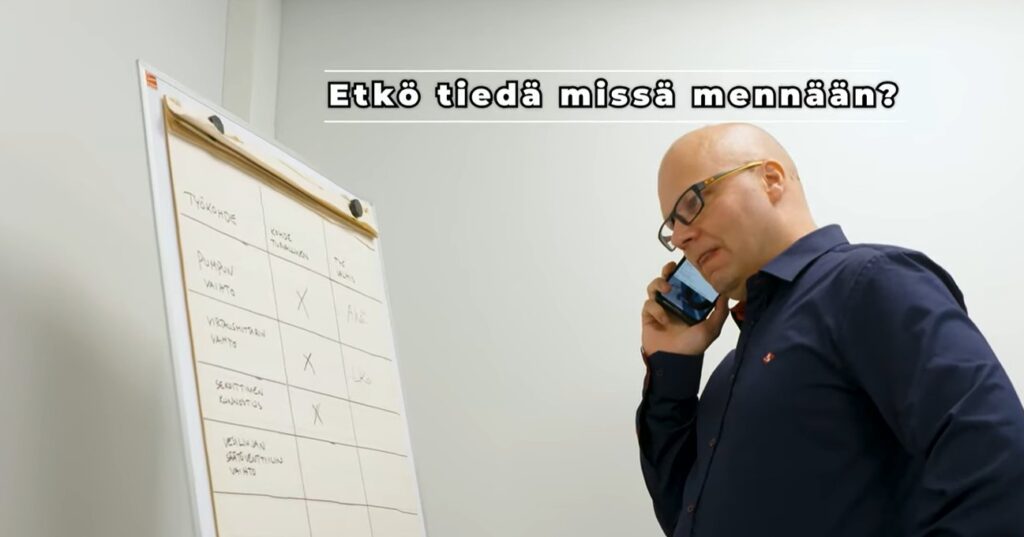
Blog Series: Challenges in Maintenance Shutdown Management | Part 2/5
Maintenance downtime is not usually delayed because people aren't working. It's delayed because the right information doesn't reach the right people at the right time.
A maintenance shutdown is one of the most demanding projects in the process industry. Dozens or even hundreds of people from various organisations work simultaneously. Each has their own responsibilities, but not everyone needs to see the entire big picture – responsible personnel must see the same situational picture, while those carrying out the work need to see their own tasks and their impact on other work.
Smooth information flow is one of the most common problems.
Often the problem isn't a lack of information, but rather that the information is scattered across different systems, emails, scraps of paper, Gantt charts, Excel spreadsheets, messages, phone calls and people's memories.
1. Plans change – but information doesn't travel
During a maintenance shutdown, plans are constantly changing.
The work will be postponed. Another job will be completed earlier than expected. A surprising fault has been found in the equipment. A new work step is needed.
If changes are not communicated quickly to all parties, this leads to delays, duplicated work, and unnecessary interruptions.
2. Each contractor has their own way of communicating
One uses email. Another calls. A third sends a WhatsApp message.
Although everyone is acting correctly from their own perspective, the whole quickly begins to fall apart. Information does not travel through a single channel, but rather becomes fragmented into several parallel conversations and documents.
This easily leads to a situation where the same thing is handled in multiple places in different ways – and eventually, no one is entirely sure which information is the latest or correct.
3. Situational awareness is based on enquiries
In many shutdowns, the same question is repeated tens of times a day:
”What stage is this work at?”
When answers need to be retrieved through calls, text messages or meetings, experts' time is spent on conveying information instead of actual work.
4. Safety information does not always follow the work.
During maintenance shutdowns, the security situation is constantly changing.
Work permits, LOTOTO procedures, and risk assessments are the foundation of safe work. If this information is located in a different place to the work tasks themselves, the possibility of errors increases.
From a safety perspective, having the right information at the right time is just as important as the work itself.
5. Those responsible do not have a common situational picture
One sees the schedule. Another the resources. A third the contractors' situation.
But who can see the entire maintenance outage at a glance?
Without a common operational picture, decisions are easily made based on outdated information.
It's not about the quantity of communication
There's a lot of communication during maintenance shutdowns.
The problem is not usually too little communication. The problem is that information travels via numerous different channels, and not everyone has access to the same up-to-date picture of the situation.
When all parties can see the same situation in real-time, the number of calls decreases, decision-making speeds up, and the entire management of maintenance downtimes becomes easier.
Summary
A successful maintenance shutdown is not solely achieved through good planning or skilled personnel.
It arises from the fact that the right information is available to the right people at the right time.
Before the next maintenance shutdown, it's worth asking a simple question:
Does everyone see the same snapshot of the situation – or is information still travelling via emails, calls, and sticky notes?
This article is part of a blog series
This writing belongs Challenges in Maintenance Stoppage Management - blog series, where we discuss the most common challenges related to planning, managing, and executing maintenance shutdowns.
In the following section:
Safety must not be overshadowed by information flow?
How do information flow, work permits, LOTOTO procedures and an up-to-date situational picture affect safe working during a maintenance shutdown.
Would you like to identify the biggest bottlenecks in your maintenance downtime?
Tool4pro's experts will help identify the biggest bottlenecks in your maintenance shutdowns and assess how they can be reduced through better planning, information flow, and a shared situational picture.
 Suomi
Suomi  English (UK)
  Svenska
  Português
  Español
  한국어
한국어  简体中文
简体中文