
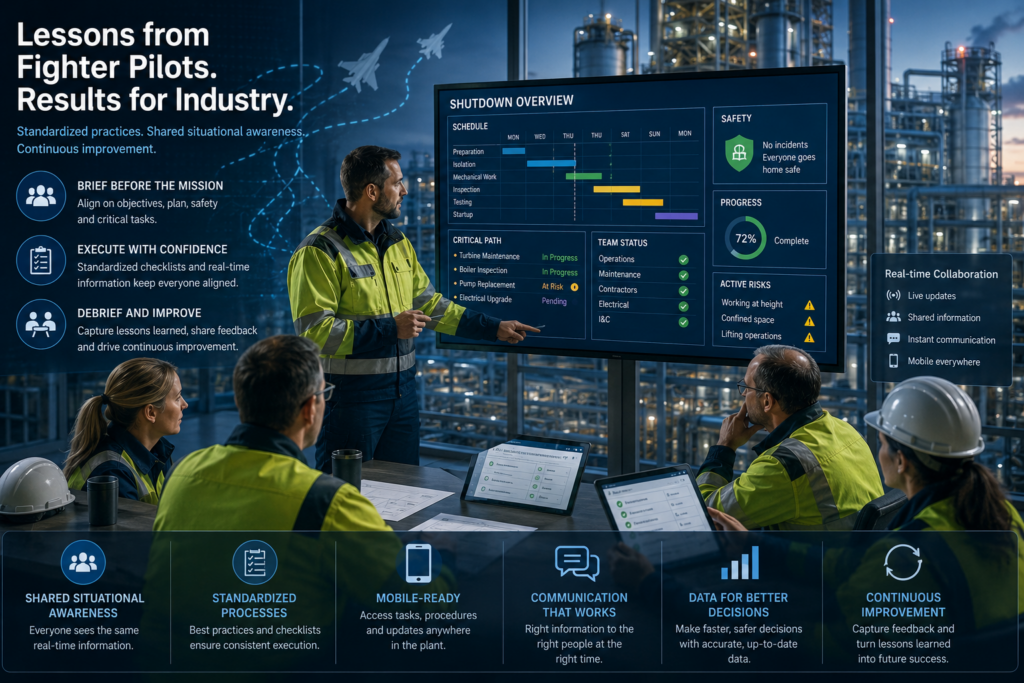
More than one might think at first glance.
Fighter pilot operations are governed by precisely defined operating models, clear communication, and continuous learning. Briefings ensure a shared understanding before a mission, while debriefings allow for learning from successes and mistakes afterwards. Checklists support operations in demanding situations, and decisions are often made quickly, even with incomplete information.
Even though the operating environments are different, the same challenges are familiar in the process industry too. Maintenance shutdowns, startups, and disturbance situations require seamless cooperation between several teams, a shared situational picture, and the ability to act effectively under pressure.
Tool4pro has also been developed to support these very operating models. Digital tools do not replace skilled people, but they can help share information, standardise practices, and support continuous learning throughout the organisation.
In the process industry, during maintenance shutdowns, start-ups, and in upset conditions, several different teams often operate simultaneously. In these situations, the following aspects become more prominent:
✔️ common operating picture
Standard operating procedures
✔️ clear checklists
✔️ Real-time information sharing
Secure and fast decision-making
Continuous learning and feedback
Tool4pro helps to implement these operating models digitally.
For example, brief and debrief practices can be integrated into daily operations. Before starting work, teams can be given a shared situational overview, critical work steps, safety matters, and objectives. After work, observations, feedback, and deviations can be documented in a shared view for learning and continuous improvement.
At the same time, checklists, work steps, and instructions are available to everyone in the field via mobile in real time. This helps ensure that information flows consistently between different teams, even in busy situations.
Perhaps the most important lesson in fighter flying is not speed, but systematicity. When operating procedures, communication, and a shared common operating picture are in order, it is possible to operate more safely, effectively, and predictably, even under pressure.
Therefore, valuable lessons can be found in the operational models of fighter pilots for industry as well – and it is precisely in their practical implementation with digital tools that a significant difference can be made.
 Suomi
Suomi  English (UK)
  Svenska
  Português
  Español
  한국어
한국어  简体中文
简体中文